Reginald Key'Shawn Billups

Building systems that automate work and move ideas into production.

Software Engineer focused on backend development, CI/CD automation, developer tooling, and intelligent applications.

PythonCI/CDAutomationTypeScript
Reginald Key'Shawn Billups in a pinstripe suit.

STATUS: AVAILABLE

TARGET: REMOTE ENGINEERING

FOCUS: AUTOMATION / SYSTEMS

Selected Work

Selected Engineering Work

A mix of sanitized enterprise case studies and public software projects spanning automation, mobile development, machine learning, and developer tooling.

Featured ProjectSanitized Case Study

Sanitized Engineering Case Study

Python Automation · Requirements Engineering · Document Generation

Enterprise Requirements-to-Document Automation Workflow

Internal workflow concepts presented with fictional data

A Python-based automation workflow that transforms structured requirements data into consistent, template-driven engineering documents and repeatable validation artifacts.

Sanitized internal case study — not open-source, publicly deployable, or independently hosted.

PythonObject-Oriented DesignPyTestDocument GenerationRequirements TraceabilityConfiguration-Driven WorkflowsValidation Automation
Featured ProjectPublic Repository

Mobile Product Engineering · Location-Based Systems

NextUp — Pickup Basketball Coordination App

React Native · Expo · Supabase

A location-based React Native app that helps basketball players discover nearby courts, organize pickup games, and coordinate attendance.

Nearby court discoveryLocation-based searchGame creationRSVP coordinationReal-time attendance updatesCourt activity visibilityAuthentication and profile workflows
Expo Mobile App
Supabase
Google Places API

Edge Functions proxy · Realtime RSVP · RLS

NextUp court discovery screen showing nearby basketball courts
Court discovery
NextUp game details screen with RSVP player list
Game details & RSVP
NextUp authentication and sign-in flow
Auth flow
Featured ProjectPublic Repository

Python Automation

Python Automation · Event-Driven Systems

Discord Community Engagement Automation Bot

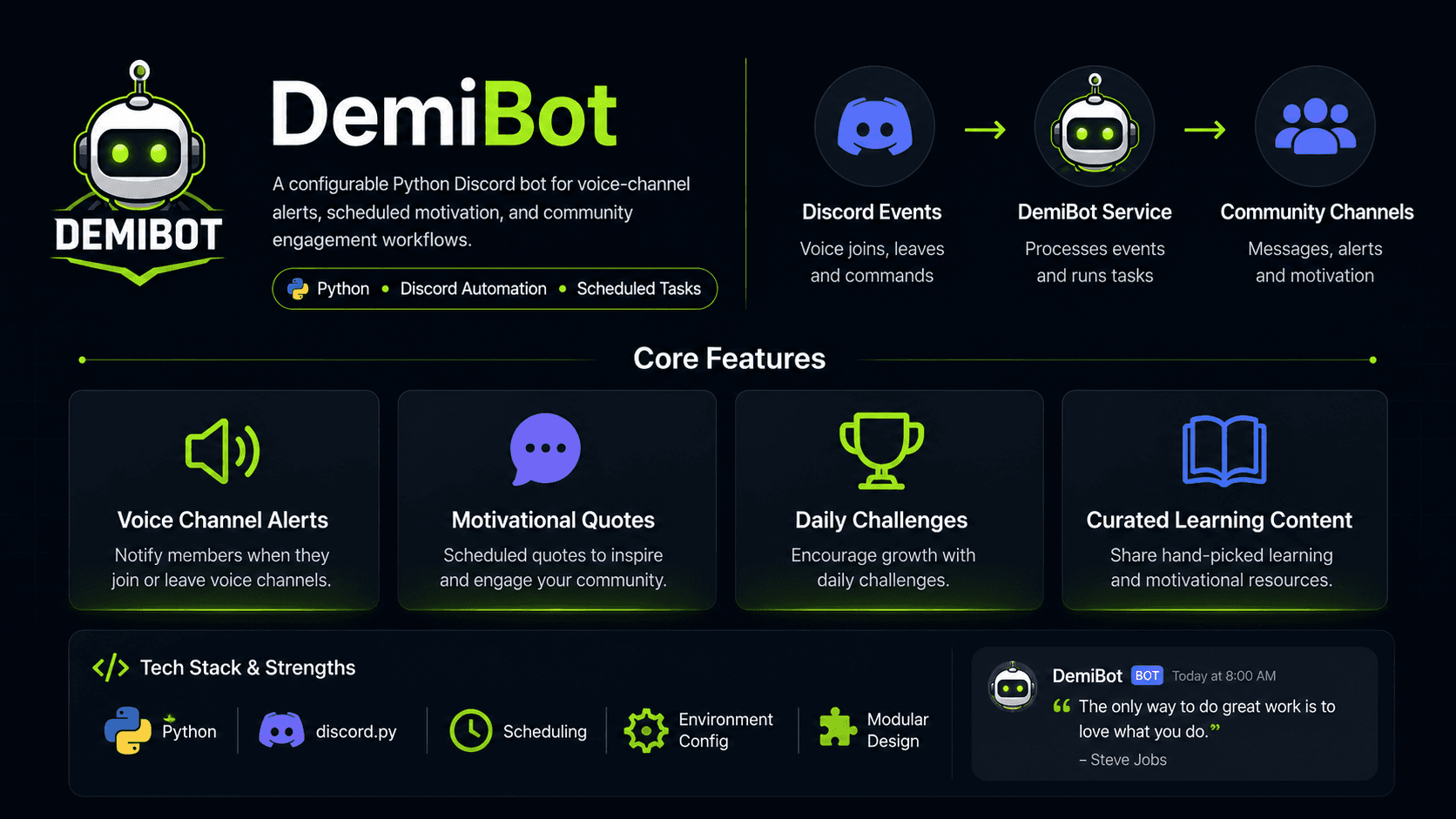
A configurable Python Discord bot that automates voice-channel activity alerts, scheduled motivation, daily challenges, and curated learning content for online communities.

Pythondiscord.pyScheduled TasksJSON Content DataEnvironment ConfigurationHeroku Worker Deployment
Discord community engagement automation bot overview
Featured

Computer Vision / ML

Computer Vision · Machine Learning

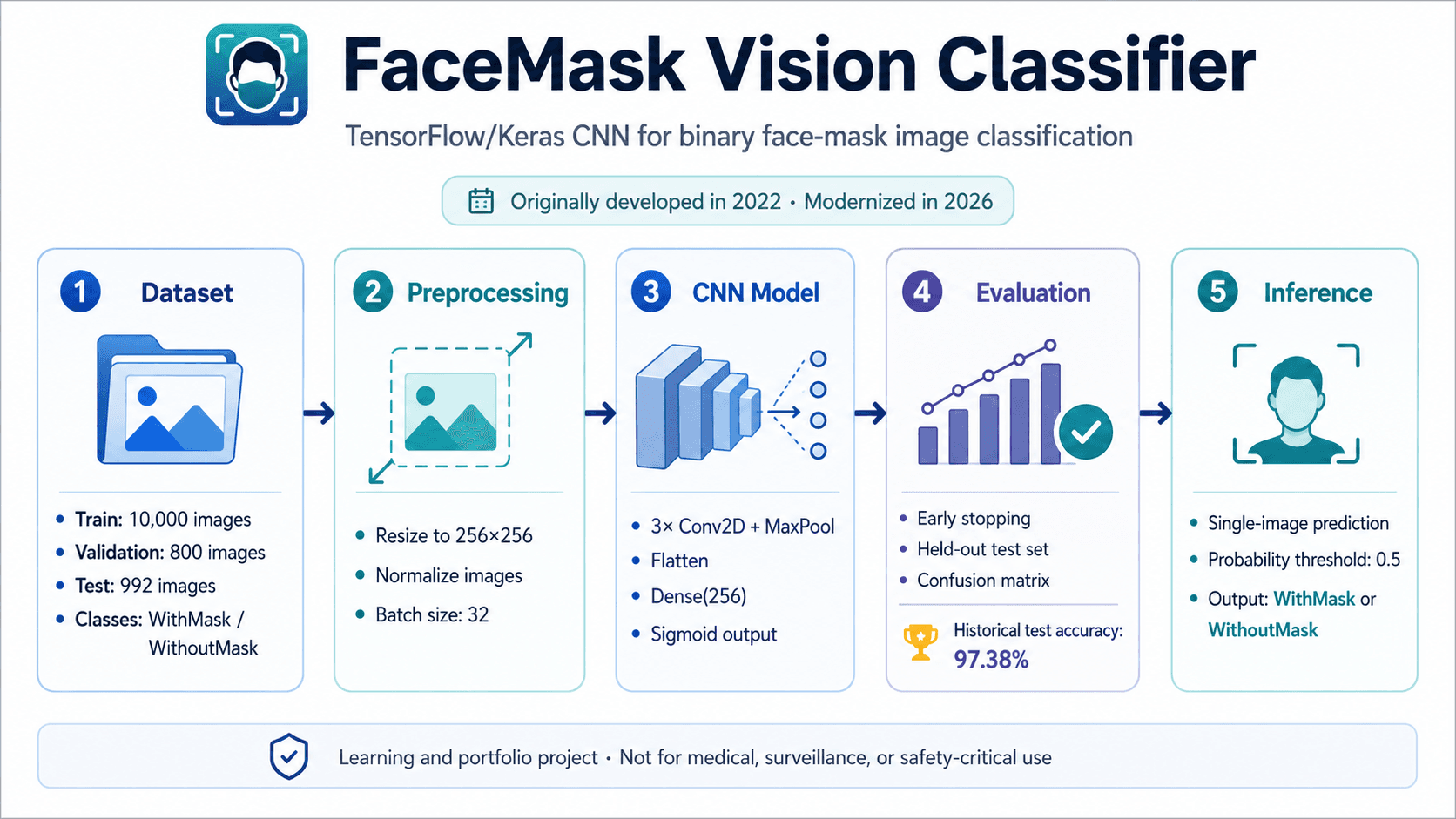
FaceMask Vision Classifier

Originally developed in 2022 · Modernized in 2026

Historical notebook result: 97.38% test accuracy

Historical result from the original notebook; refactored evaluation should be rerun with the dataset.

A TensorFlow/Keras convolutional neural network for binary face-mask image classification, combining image preprocessing, CNN training, held-out evaluation, and single-image inference.

PythonTensorFlowKerasCNNComputer VisionNumPyMatplotlibSeabornScikit-learnPyTest
View Case StudyRepository Coming Soon
FaceMask Vision Classifier project overview
In Development

DevOps

CI/CD-Ready Python Service Template

Dockerized Python backend template with tests, linting, CI pipeline examples, environment variables, and deployment-ready structure.

PythonDockerGitHub Actionspytest
Source
CI
Docker
Deploy
Tests
Lint
Env Config
Repository In Development

Sanitized Case Study

Requirements-to-Document Automation Toolkit

A sanitized case study showing how I approach Python automation, object-oriented architecture, template-driven generation, and repeatable validation workflows for requirements-heavy engineering environments.

Python AutomationObject-Oriented DesignPyTestDocument GenerationRequirements TraceabilityConfiguration ManagementValidation WorkflowsEngineering Tooling

This case study intentionally uses fictional names, examples, and workflow representations. No proprietary code, customer data, requirements data, templates, or internal artifacts are displayed.

The problem

Engineering teams often rely on manually assembling documents from structured requirements data, approved templates, and configuration-specific information. Manual workflows can create formatting inconsistencies, repetitive effort, and difficulty reproducing validation evidence across document variations.

The solution

A Python automation workflow that reads structured inputs, applies configurable generation rules, populates approved document structures, and produces standardized output artifacts through reusable object-oriented components.

System design

Object-oriented architecture

  • A shared base document abstraction centralizes common behavior such as loading context, validation setup, rendering, output handling, and logging.
  • Specialized document handlers extend common behavior for different document structures and workflow needs.
  • Helper services isolate responsibilities such as structured-data handling, table generation, configuration interpretation, and traceability support.
  • This design reduces duplication and makes the workflow easier to extend and test.

Automated Validation with Targeted Manual Verification

Designed a repeatable qualification and regression-testing workflow for document-generation automation. The approach used controlled structured inputs and automated comparison scripts to verify generated document content, while retaining targeted manual checks for output characteristics that require human review.

How the workflow worked

  1. 1. Defined controlled test inputs

    Created a controlled set of structured requirements data and reference exports representing the expected document content.

  2. 2. Executed the generation workflow

    Ran the Python automation workflow using approved templates and configuration inputs to produce standardized document outputs.

  3. 3. Automated content comparison

    Used Python-based validation scripts to compare authoritative structured source artifacts against tables and content produced in the generated document.

  4. 4. Evaluated pass or mismatch conditions

    The automated workflow recorded a pass when generated content aligned with expected reference data and flagged mismatches for investigation.

  5. 5. Performed targeted manual checks

    Used manual review for template replacement, visual formatting, deleted or changed content, and required output artifacts that were not appropriate for purely automated verification.

Why it matters

This approach made rollout and release-readiness more repeatable by pairing automated evidence with focused human review, rather than relying on manual document inspection alone.

PyTestPython AutomationStructured Data ValidationRegression TestingTest Procedure DesignQualification SupportDocument GenerationRequirements Traceability

Engineering decisions

  • Configuration-driven behavior to support workflow variation without duplicating core logic
  • Object-oriented abstractions to share common document-generation behavior
  • Separation of input parsing, generation logic, and output validation
  • Automated tests with PyTest to improve regression confidence
  • Repeatable test procedures designed to support qualification and release-readiness activities
  • Clear boundaries between reusable utility services and document-specific logic

What this demonstrates

Python AutomationObject-Oriented DesignPyTestDocument GenerationRequirements TraceabilityConfiguration ManagementValidation WorkflowsEngineering Tooling

Confidentiality note

All workflow visuals, examples, and labels in this case study are intentionally generalized and fictionalized for public portfolio use. This work is not open-source, publicly deployable, or represented as a live product offering.

Case Study

NextUp — Pickup Basketball Coordination App

NextUp is a mobile app designed to make pickup basketball easier to organize by helping players discover nearby courts, create games, RSVP, and see planned activity at each location.

The problem

Pickup basketball is still coordinated through group chats, last-minute texts, and guesswork. Players waste time trying to figure out which courts have games forming, who plans to attend, and whether a session is worth the trip. The core problem is coordination friction — not a lack of interest.

The solution

NextUp is a React Native mobile app built to reduce that friction. Players can discover courts through foreground GPS or manual city/ZIP search, create games at a specific court, and RSVP so everyone can coordinate attendance and see planned player activity before they leave. The product goal is practical coordination — not social feed mechanics or live public launch claims.

Architecture

Expo Mobile App
Supabase
Google Places API

Edge Functions proxy · Realtime RSVP · RLS

  • Expo mobile client handles navigation, auth sessions, court discovery UI, game creation, and RSVP interactions.
  • Supabase provides Auth, Postgres persistence, Row Level Security, and Realtime channels for live RSVP updates.
  • Supabase Edge Functions proxy Google Places requests server-side so API keys never ship in the client bundle.
  • Postgres tables model courts, games, RSVPs, and user-linked activity with RLS enforcing per-user access boundaries.

Engineering decisions

Foreground GPS + manual search

Court discovery supports both device location while the app is in use and explicit city/ZIP entry, giving players control without background tracking overhead.

Auth-gated actions with deferred completion

Game creation and RSVP flows require authentication. If a user initiates an action before signing in, the app preserves intent and completes the action after sign-in instead of forcing a restart.

Realtime RSVP updates

Supabase Realtime keeps game attendance visible as players join or drop, so coordination data stays current without manual refresh loops.

Server-side Places integration

Google Places lookups run through Edge Functions, keeping third-party credentials off the client and centralizing request validation.

Privacy and security decisions

  • No background location tracking — GPS is used in the foreground during active discovery only.
  • Manual check-in instead of geofencing, avoiding continuous location inference.
  • Row Level Security on Supabase tables so users only read and write data they are authorized to access.
  • API keys for Google Places stored server-side behind Edge Functions, not embedded in the mobile app.

Screenshots

NextUp court discovery screen showing nearby basketball courts
Court discovery
NextUp game details screen with RSVP player list
Game details & RSVP
NextUp authentication and sign-in flow
Auth flow
NextUp user profile and court activity view
Profile & activity

Source Code

Explore the public repository, architecture, and implementation details on GitHub.

NextUp is a public development repository and portfolio project. It is not listed in the App Store, not marketed as live for public users, and not presented as a fully production-deployed consumer product.

Case Study

DemiBot — Community Automation System

A Python automation case study focused on event-driven Discord workflows, scheduled community content, and environment-based configuration.

The problem

Communities often rely on repeated manual reminders, moderation effort, and ad hoc updates to keep members engaged and informed. DemiBot was built to automate recurring engagement workflows while keeping the system configurable and lightweight.

The solution

A configurable Discord automation service that reacts to community events and delivers scheduled motivation, challenges, voice-channel notifications, and curated learning content.

Verified capabilities

  • Detects and reports voice-channel join and leave activity
  • Delivers scheduled motivational quotes and daily challenges
  • Serves curated learning and motivational content
  • Uses environment variables for bot tokens and channel configuration
  • Rotates content through structured JSON datasets
  • Runs as a background worker deployment rather than a traditional web application

Architecture

Discord Events + Scheduled Jobs
DemiBot Python Service
Environment Configuration + JSON Content Libraries
Discord API + Configured Channels

Key engineering decisions

Event-driven listeners

Voice-channel join and leave activity is handled through Discord event listeners so alerts stay tied to real community activity.

Background scheduled tasks

Recurring motivational quotes, daily challenges, and curated content run on scheduled tasks without manual intervention.

Environment-based configuration

Bot tokens and channel routing are loaded from environment variables so deployment settings stay separate from application logic.

JSON content separation

Structured JSON datasets hold motivational and learning content so libraries can evolve without rewriting core bot logic.

Worker-process deployment

A Procfile-backed worker model supports persistent bot operation rather than a traditional request-response web application.

Public-safe repository structure

A .env.example template documents required configuration while local secret files remain excluded from version control.

Security and configuration

  • Sensitive values such as bot tokens are configured through environment variables rather than hard-coded in source files.
  • The public repository includes a .env.example template that documents required configuration without exposing secrets.
  • Local environment files containing real credentials are excluded from version control.
  • Channel routing and bot behavior are driven by configuration so the same codebase can support different deployment contexts.

Visual overview

DemiBot architecture and core feature overview

Repository

Explore the public DemiBot repository, configuration model, and automation implementation on GitHub.

Computer Vision / ML

FaceMask Vision Classifier

A computer-vision learning project originally built in 2022 during my AI concentration and modernized in 2026 with improved evaluation logic, reusable project structure, and reproducibility-focused engineering updates.

Python AutomationTensorFlowKerasCNN DesignImage PreprocessingBinary ClassificationModel EvaluationPyTestComputer Vision
Historical notebook result: 97.38% test accuracy

Historical result from the original notebook; refactored evaluation should be rerun with the dataset.

FaceMask Vision Classifier project overview

Project History

2022 — Original Implementation

  • Built the original TensorFlow/Keras notebook
  • Loaded labeled image datasets
  • Trained a binary CNN
  • Used early stopping and held-out test evaluation
  • Added confusion-matrix analysis and image inference

2026 — Engineering Modernization

  • Corrected sigmoid threshold and confusion-matrix logic
  • Reorganized notebook code into reusable Python modules
  • Added train.py, evaluate.py, and predict.py scripts
  • Added centralized configuration and lightweight PyTest coverage
  • Removed Colab-specific paths from reusable code

Dataset and Preprocessing

  • Separate Train, Validation, and Test folders
  • Two labeled classes: WithMask and WithoutMask
  • Historical split: 10,000 train, 800 validation, 992 test images
  • Image resizing to 256 × 256
  • Consistent normalization and batched loading
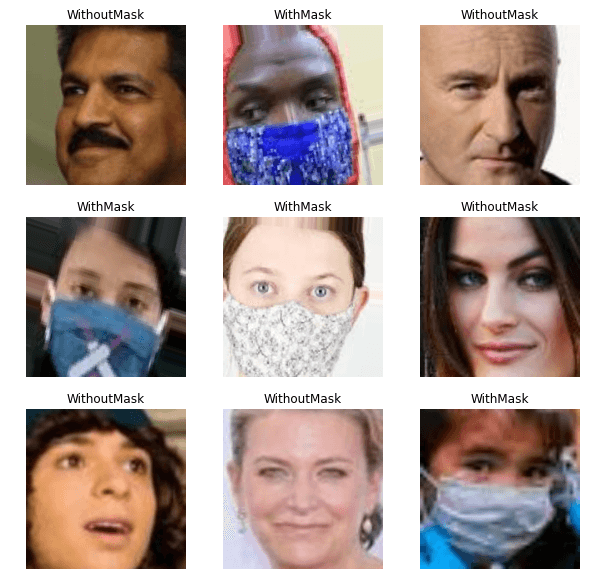
Sample labeled face-mask dataset images

Example labeled images from the original dataset workflow, illustrating the WithMask and WithoutMask classes.

Model Architecture

The sigmoid output represents the probability of the WithoutMask class under the original class ordering: 0 = WithMask, 1 = WithoutMask.

Training and Evaluation

  • Adam optimizer
  • Binary cross-entropy loss
  • Early stopping based on validation loss
  • Separate held-out test evaluation
  • Historical test accuracy: 97.38%

Evaluation note

This metric was produced by the original notebook. The corrected threshold-based evaluation should be rerun with the original dataset to produce an updated confusion matrix and reproducible report.

Engineering Fix and Modernization

The original notebook used argmax on a single sigmoid output during post-training prediction analysis. In the modernization, prediction handling was corrected to use a 0.5 probability threshold, enabling valid binary labels and confusion-matrix analysis. This was an engineering improvement discovered during refactoring — not a replacement of the original 2022 machine-learning work.

Responsible Use

This is a learning and portfolio computer-vision project. Performance may vary based on image quality, lighting, image diversity, camera angle, and class balance. It is not intended for medical, surveillance, enforcement, or safety-critical decisions.

Skills Demonstrated

Python AutomationTensorFlowKerasCNN DesignImage PreprocessingBinary ClassificationModel EvaluationPyTestComputer Vision

Career

Professional Experience

Engineering roles focused on automation, software quality, CI/CD, and requirements-driven development.

Lockheed Martin Aeronautics

2023 — Present
Associate Software Engineer (E1)Software Engineer (E2)

Software Engineer with three years of experience building automation tools, enhancing engineering applications, and supporting requirements-driven software workflows. Focused on Python development, object-oriented design, test automation, CI/CD pipelines, and developer tooling.

  • Develop and enhance Python-based automation tools that support engineering workflows and reduce repetitive manual effort.
  • Design and implement object-oriented software features, maintain existing functionality, and contribute to ongoing product improvements.
  • Create and maintain automated tests using PyTest to improve software quality, regression coverage, and confidence in releases.
  • Build and support GitLab CI/CD pipelines using Docker-based environments and AWS-hosted runners.
  • Work with IBM Engineering Requirements Management DOORS to support requirements-driven development, traceability, and engineering documentation workflows.
  • Develop DXL scripts to automate and improve DOORS-based requirements processes.
  • Collaborate with engineers and stakeholders to troubleshoot issues, refine workflows, and deliver maintainable software solutions.
  • Contribute to validation, qualification, and release-readiness activities for internal engineering tools.
PythonPyTestObject-Oriented DesignGitLab CI/CDDockerAWS RunnersIBM DOORSDXLAutomationRequirements Traceability

Project examples are intentionally generalized to protect proprietary, customer, and program-sensitive information.

Carter Brothers

May 2022 — Aug 2022

Software Analyst Intern

Kennesaw, GA

Supported web-based application development, UI planning, issue resolution, reporting, and technical documentation in a collaborative software environment.

  • Created and tested UI wireframes and application features for web-based software workflows.
  • Contributed to application development using HTML, JavaScript, and jQuery.
  • Supported reporting, requirements clarification, issue investigation, and resolution activities.
  • Documented technical findings and collaborated with stakeholders to improve feature clarity and implementation quality.
HTMLJavaScriptjQueryUI WireframesRequirements ClarificationReportingIssue ResolutionTechnical Documentation

Wilcom Electrical Systems

May 2021 — Aug 2021

Application Support / Developer Intern

Marietta, GA

Supported back-office applications and production support activities while gaining hands-on experience with deployment, testing, troubleshooting, reporting, and technical documentation.

  • Maintained back-office applications and assisted with deployment, testing, troubleshooting, and documentation for production support activities.
  • Created and updated programs on web and application servers in support of internal business operations.
  • Produced custom reports for operational stakeholders and helped improve visibility into application and business-process data.
  • Collaborated with technical team members to investigate issues, support releases, and document application changes.
Application SupportWeb/Application ServersTestingTroubleshootingReportingDocumentationProduction Support

Credentials

Selected Achievements & Education

Selective highlights in applied engineering, competition work, and academic foundation.

Selected Achievements

2nd PlaceMarch 2022

2nd PlaceKSU Hackathon for Social Good

Kennesaw State University · Sponsored by HPCC Systems and LexisNexis Risk Solutions

Team: CS Knights — Key'Shawn Billups and Trevor Fouce

Placed second in a weeklong social-impact hackathon focused on improving how young adults aging out of foster care could be matched with mentoring families. Built a data-driven mentor-matching solution using HPCC Systems and ECL, with a ROXIE-first approach centered on a user-friendly interface for querying and evaluating potential matches.

  • Learned and applied ECL in a time-constrained hackathon environment
  • Designed a ROXIE-first query workflow for mentor matching
  • Built configurable STORED workflow services and SOAP-style query parameters
  • Focused on an end-user interface for input-driven mentor recommendations
3rd PlaceSummer 2022

3rd PlaceKSU CCSE Ideathon

Kennesaw State University College of Computing and Software Engineering · Partnered with BlackRock

Placed third in Kennesaw State University's Summer 2022 CCSE Ideathon, a collaborative innovation event where student teams developed and pitched solution ideas addressing sustainable business practices with positive performance impact.

  • Collaborated in a fast-paced team ideation and problem-solving environment
  • Developed a structured solution concept for an open-ended sustainability-focused business challenge
  • Applied classroom knowledge to a real-world industry problem
  • Prepared and delivered a concise solution pitch to BlackRock judges
  • Participated in an event designed around design thinking, development skills, and employer engagement
2nd PlaceOctober 2022

2nd PlaceKSU Fall Hackathon

Kennesaw State University · Presented by Assurant

Team: Key'Shawn Billups and Trevor Fouce

Placed second in Kennesaw State University's Fall 2022 Hackathon. Teams were challenged to create a technology-driven solution around the theme "Helping people thrive in a connected world," then present their ideas to a panel of judges.

  • Collaborated in a time-constrained team software-design environment
  • Translated an open-ended problem statement into a proposed technical solution
  • Presented the final concept and implementation approach to judges
  • Participated in industry mentorship and networking opportunities

Education

Graduated May 2026

Kennesaw State University

Master of Science, Cybersecurity

GPA: 4.0

Graduated May 2023

Kennesaw State University

Bachelor of Science, Computer Science

Concentration: Artificial Intelligence

Foundation

Software EngineeringCybersecurityArtificial IntelligenceData StructuresObject-Oriented ProgrammingSystems Design

About

SOFTWARE ENGINEER · AUTOMATION · PRODUCT DEVELOPMENT

Reginald Key'Shawn Billups is a Software Engineer focused on building reliable automation, maintainable developer tools, and user-centered software products.

His work combines Python development, object-oriented design, test automation, requirements-driven engineering workflows, and modern product development. He enjoys solving operational problems by reducing repetitive effort, improving software quality, and turning complex workflows into dependable systems.

Currently focused on Python automation, developer tooling, CI/CD-adjacent quality workflows, mobile products, and practical AI/ML foundations.

Backend & Automation

  • Python
  • Object-Oriented Design
  • APIs
  • Data Processing
  • Script Automation
  • PyTest
  • Requirements-Driven Workflows

DevOps & Quality

  • GitLab CI/CD
  • Docker
  • Automated Testing
  • Git
  • GitHub Actions
  • Configuration Management
  • Validation Workflows

Product & Platform Engineering

  • React Native
  • Expo
  • Supabase
  • TypeScript
  • PostgreSQL
  • Event-Driven Automation
  • TensorFlow / Keras

Contact

Let's build something reliable.

Open to engineering roles, automation projects, and collaborations on tools that ship.